Scaling AI Projects: How to Choose the Right Cloud Infrastructure
Though AI has been around for some time now, its application by businesses and industries is still on the rise and is expected to have an even greater impact in the coming years. The use of AI in various forms, from predictive analytics and natural language processing to computer vision and recommendation systems, is escalating pretty fast. But the successful scaling of AI projects calls for not only skilled people but also proper and well-performing cloud infrastructure that is able to serve the unstable AI workloads quickly and effectively.
The Cloud for AI initiative aims to support corporations in choosing and putting into operation the best possible AI infrastructure, thus guaranteeing that the resources are completely used, the expenses are controlled, and the performance can grow along with the projects without any problems.
Understanding AI Workloads and Their Demands
Before making a decision about a cloud infrastructure, it is very important to grasp the characteristics of the AI workloads. AI workloads are not like traditional IT workloads; they are very dynamic and take up a lot of resources. Besides, AI is all about big data, which means that the models trained and fine-tuned with massive datasets need high-speed storage and efficient I/O. And the computational power is enormous as well: deep learning models, such as convolutional neural networks and transformers, require a lot of parallel processing.
The continuous process of experimentation, covering aspects like iterative training and hyperparameter tuning, increases the need for different resources. Moreover, large-scale inference implies that there should always be low-latency responses with high quality for real-time applications. All these reasons point to the fact that traditional servers and on-premise setups are not sufficient anymore, thus there is a demand for GPU cloud servers and scalable cloud infrastructure.
Why GPU Cloud Servers Are Essential for AI
One of the main components of an AI infrastructure with high performance would definitely be the GPU cloud server. The parallel computing ability of the GPUs makes them a very good choice for AI model training and inference.
Advantages of GPU Cloud Servers:
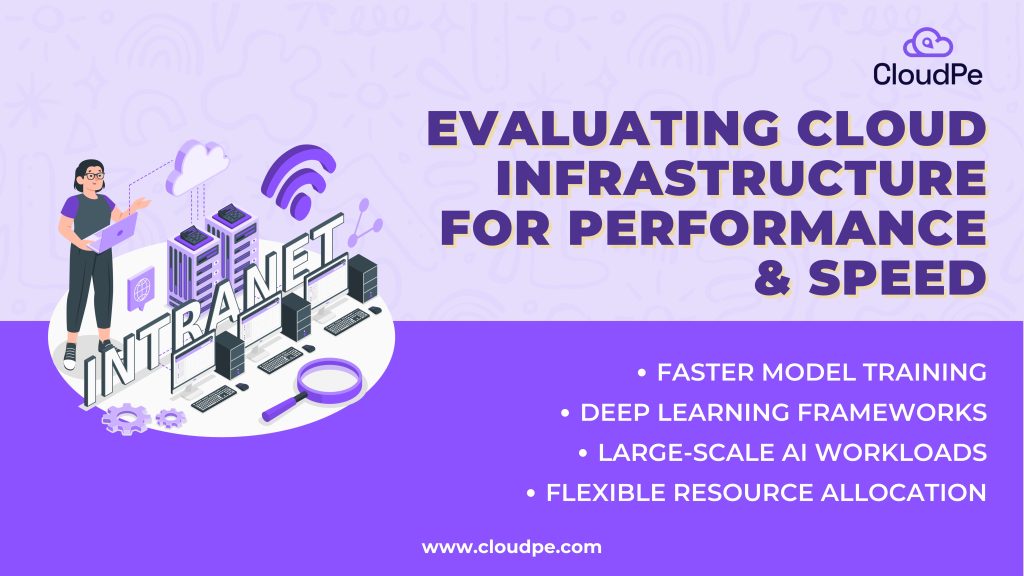
- Faster model training: The use of GPUs enables handling of vast matrices and tensors in parallel, which results in a significant reduction in the time taken to train intricate models.
- Support for deep learning frameworks: Major frameworks such as TensorFlow, PyTorch, and JAX are all geared towards needing GPU power.
- Handling large-scale AI workloads: Multi-GPU setups allow training on massive datasets without bottlenecks.
- Flexible resource allocation: Cloud-hosted GPUs enable the necessary resources for businesses to increase or decrease dynamically to coincide with the workload requirements.
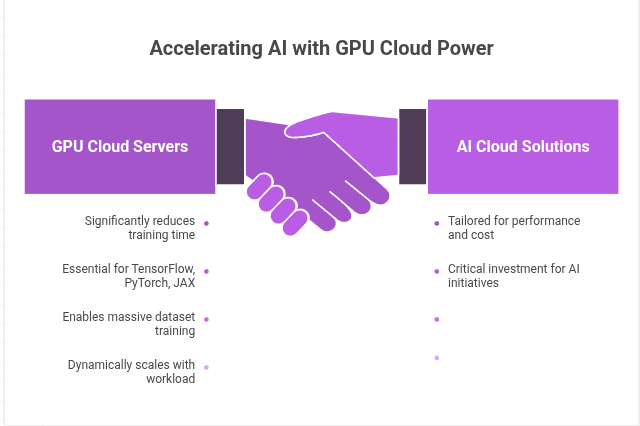
By and large, organisations willing to adopt AI at an enterprise level view GPU cloud servers as a critical investment rather than an option. This is where the AI cloud comes into play through custom GPU solutions that not only perform but also keep the costs low.
Cloud Scalability: Adapting to Growing AI Needs
One of the most important advantages of cloud infrastructure is cloud scalability. Traditional on-premise servers do not have this feature, but cloud platforms enable companies to rapidly expand or reduce their resources according to the needs of their projects.
Key Aspects of Cloud Scalability:
- Elastic compute resources: The processing power of both CPUs and GPUs can be easily increased or decreased depending on the activity stage, that is, either training or inference.
- Storage flexibility: Datasets are getting larger, but storage can still be expanded without impacting ongoing operations.
- Global deployment: Put AI models near the users, thus lessening the delay and enhancing the quality of service.
- Automated scaling: Advanced cloud platforms can automatically allocate resources based on real-time workload demands.
Scalability allows organisations not to spend money on unused resources during slow times while still managing the surge in processing needs. The AI’s cloud is an expert in using the scalable infrastructure professionally, which changes according to your project needs without any hassle.
Optimising Compute Resources for AI
The scaling of AI projects really depends on how well computing resources are used. If resources are not managed properly, it could lead to unnecessary costs, longer model training times, and reduced output.
Best Practices for Compute Resource Optimisation:
- Right-sizing resources: Align server specifications to workload requirements in order to circumvent both under-utilisation and bottlenecks.
- Job scheduling: Deploy smart orchestration such that several training or inference activities can unfold at the same time without overlapping in resources.
- Multi-GPU setups: Share the workload over various GPUs, thus making the whole process of large-scale AI operations lightly burdened and more efficient.
- Monitoring and analytics: Watch the usage statistics in order to detect the presence of inefficiencies and make the necessary adjustments to the resources before the issue escalates.
Through the optimisation of computing resources, companies can easily realise the benefits of shorter training times, reduced costs, and superior performance overall. AI cloud offers such solutions that rely on the computational strength and operational efficiency, and thus make sure that the AI projects grow healthily.
Supporting Large-Scale AI Solutions
The process of Scaling AI is not limited to the physical infrastructure alone, but rather allows the AI applications to perform large-scale operations efficiently. Every step that takes place in a recommendation engine for the processing of millions of transactions or every high-resolution image for medical diagnostics has to be supported by a very strong cloud infrastructure that can bear the huge load.
The absolute minimum prerequisites include fast data access via high-bandwidth storage and memory, fast networking with low latency between computers for distributed training, redundant systems for reliability and uptime, and advanced orchestration tools for workload management. AI cloud helps organisations to build infrastructures that are able to bear such heavy AI workloads; thus, the models’ efficient operation at scale is guaranteed.
The Role of Managed AI Cloud Services
The handling of sophisticated AI systems can give nightmares to most businesses. A managed cloud service is a solution because it assumes the responsibility for heavy lifting, which includes installation, monitoring, scaling, and maintenance.
Benefits of Managed AI Cloud Services:
- Easier setup: Deploy GPU servers and AI platforms rapidly without laborious manual configuration.
- Built-in monitoring: Monitor performance, resource consumption and costs in real-time.
- Faster deployment: Quickly move AI models to production, thus minimising time-to-value.
- Expert support: Upon learning the needed specialised skills at work, you can overcome obstacles as well.
Getting managed services frees organisations to spend time and money on developing AI solutions, not on dealing with infrastructure from the ground level. Cloud for AI delivers end-to-end managed cloud services that enable ROI at scale and enhance operational engagement.
Planning for Future Growth
AI projects are not static; they are constantly moving and changing. Proper scaling of a project will necessitate the use of infrastructure that is capable of expanding together with your initiative.
Strategies for Future-Proof AI Infrastructure:
- Elastic resource allocation: Ensure that the resources of CPU, GPU, and storage are capable of scaling as data does.
- Multi-region support: Global deployment of the model will be vital in order to cater to a massive user base.
- Flexible cloud architecture: Avoid vendor lock-in by using open standards and containerised solutions.
- Performance monitoring: Continuously analyse workload performance and adjust resources accordingly.
By planning for growth, businesses can avoid bottlenecks and ensure consistent performance, even as AI workloads increase in size and complexity.
Security and Compliance Considerations
While scaling AI projects, it is also necessary to consider the important issues of data security and compliance. Sensitive information is often included in large datasets and, therefore, cloud infrastructure must not only protect such data but also comply with the legal requirements. Critical security characteristics include data encryption when not used and during transmission, IAM, and regular compliance audits for GDPR and HIPAA, as well as the creation of secure multi-tenant environments.
AI Cloud incorporates these security and compliance implementations into its flexible cloud infrastructure, thus providing companies with the security to control sensitive AI workloads without jeopardising performance or scalability.
Conclusion
The implementation of AI projects at larger scales comes with the necessity of a cloud infrastructure that is backed by a solid strategy. Today’s AI workloads not only require but also exhaust the whole range of GPU cloud servers and mighty compute resources backed up by the ability to quickly adapt the cloud to changing requirements and to conduct large-scale AI projects.
AI Cloud has the required knowledge and the necessary facilities to make AI adoptable on a large scale. It is providing not just high-performance solutions but also solutions that are cheap and can be changed with the workload. Proper cloud infrastructure helps companies speed up AI development, make efficient use of models, and get the most out of the innovative power of AI.
The selection of the appropriate infrastructure is no longer a matter of choice but a necessity in AI project scaling. Your AI projects in Cloud for AI can expand without any problems, have the best performance, and provide a significant impact throughout the company.

Abhishek Ambad
Sr. Inbound Marketing Specialist