The Impact of AI and ML Workloads on Modern Cloud Platforms
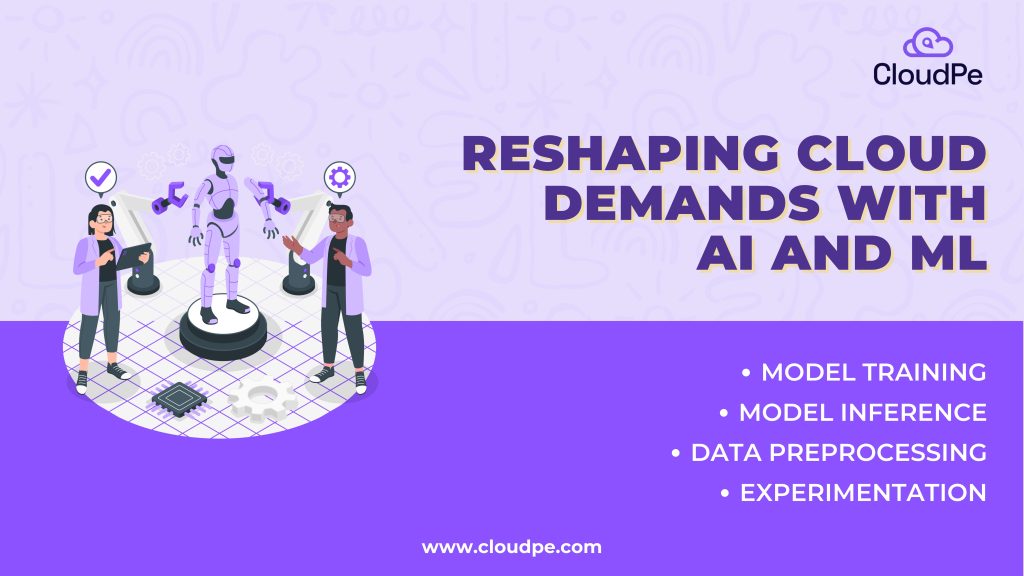
Artificial Intelligence (AI) and Machine Learning (ML) have turned to be technologies that are not just on the horizon anymore they have already become the main forces that are driving digital transformation in all sectors. Predictive analytics and recommendation systems, autonomous systems, and generative AI are a few categories where organisations have started depending more on the solutions powered by AI. As a result, traditional cloud setups are no longer sufficient.
AI and machine learning are fundamentally changing cloud infrastructure demands, forcing cloud providers and businesses to rethink how computing resources are designed, allocated, and managed.
The change has been responsible for the transformation of the AI Cloud Infrastructure, which in turn modified and improved the operations and the value delivery of the contemporary cloud platforms.
The Rise of AI and Machine Learning Workloads
AI and machine learning workloads are another universe compared to traditional IT workloads. AI workloads are not the simple ‘predictable CPU usage and standard storage’ kind of things like conventional applications; rather, they involve ‘massive datasets, complex mathematical computations, extensive parallel processing, and continuous experimentation and retraining.’
The AI adoption is increasing in all industries, and the mentioned unique workload characteristics are pushing cloud infrastructure to the limit, which is leading the cloud providers to create specific architectures, develop enhanced hardware and apply smart resource management to satisfy the performance, scalability and flexibility requirements of the modern AI applications.
What Is AI Cloud Infrastructure?
AI Cloud Infrastructure denotes the types of cloud environments that have been specifically designed and optimised to run AI and ML workloads. The combination of the latest hardware, intelligent software layers, and the management of resources through dynamism makes it possible to handle the computational power required by AI applications.
Key components include:
- High-performance CPUs and GPUs
- Accelerated networking
- Scalable storage systems
- AI-optimised frameworks and runtimes
The AI cloud infrastructure is not the classical engineered cloud infrastructure, instead created for flexibility, scalability, and unleashed performance.
How AI Is Reshaping Cloud Platforms
The contemporary cloud platforms are progressing to be on par with AI needs, thus providing more than mere virtual machines and storage. Currently, they have created entire ecosystems for Artificial Intelligence development, training, and deployment. These ecosystems consist of cutting-edge hardware, professional services, and user-friendly tools that not only speed up but also smoothen the transition from experimentation to production.
Significant modifications in cloud platforms consist of:
- AI and ML services adopted by default
- GPU and accelerator-based compute choices
- Supervised Machine Learning workflows
- Cohesive surveillance and enhancement utilities
These improvements enable companies to gradually pass the phase of experimentation and get into the production stage faster than before.
Increased Demand for Specialised Hardware
The impact of AI on cloud infrastructure is enormous, and one of the areas where it is the most pronounced is the demand for hardware that is dedicated to specific functions only. Conventional CPUs’ processing capability has become a limiting factor for machine learning models that need GPUs and AI accelerators, high-bandwidth memory, and fast interconnects among computer nodes for efficient parallel computation of large scale data.
Such a transition has reconstructed the complete picture of the cloud infrastructure design and its deployment. Presently, the main cloud providers are putting in millions of dollars into AI-specific data centres that are low-latency, high-throughput, and easily scalable up or down.
Sustainability & Energy Efficiency
The growing AI workloads are accompanied by a significant increase in energy consumption and thus, sustainability has become a very important factor during cloud selection.
- Energy-intensive nature of GPUs & accelerators: High performance GPUs and AI accelerators use extreme power, particularly at the time of training which is done on a large scale.
- Power, cooling, and data center efficiency: The very design of the power distribution, cooling systems, and the data center must be very efficient to be able to prevent energy waste.
- Smarter utilization to reduce carbon footprint: Methods like resource scaling, workload scheduling, and GPU sharing consume less energy overall and thus emit less carbon together.
- Sustainability as a cloud selection factor: The energy-pints of the provider, besides the performance and price, are the main factors that companies weigh when deciding on the cloud provider
The smarter resource allocation in the cloud
AI and machine learning workloads are extremely dynamic.In general, the training of models involves the use of huge computing power for a very short time, while inference only needs less but steady power. This situation creates a challenge for resource allocation, as the cloud infrastructure has to be able to quickly and efficiently scale up during the demanding training and scale down when less-intensive inference tasks are taking place.
How AI changes resource allocation:
- Resources must scale instantly based on workload needs.
- Infrastructure must support burst computing.
- Intelligent scheduling is required to optimise costs.
Cloud services increasingly rely on superior orchestration and automation techniques to distribute resources in an optimised manner, thus providing performance without any waste.
Orchestration, Containers & Kubernetes
Containers make AI workloads portable and lightweight, while Kubernetes automatically schedules and scales them across cloud resources.
Key benefits:
- Dynamic scaling: Resources are adjusted instantaneously to accommodate increases or decreases.
- Optimized utilization: It minimizes the amount of unused hardware, thus cutting costs as well as saving energy.
- Simplified deployment: It takes care of numerous AI job execution with little manual input.
The three of them together make possible the processing of AI workloads with a quicker turnaround, high efficiency, and at a lower cost.
The Shift Toward Elastic and On-Demand Infrastructure
Before, the classical infrastructure planning was based on over-the-top provisioning to catch every peak load, and it worked well, but with AI-driven workloads, it has become both impractical and costly.
- AI and machine learning demand
- Elastic scaling in real time
- On-demand provisioning of compute and storage
- Rapid startup and teardown of environments
Modern AI Cloud Infrastructure allows organisations to scale their resources exactly at their point of necessity, thereby significantly enhancing the effectiveness and reducing costs.
Data-Centric Infrastructure Design
AI is fundamentally data-driven. The way data is created by businesses, users, and devices has changed all the designs for cloud infrastructures.
Key data-related demands include:
- High-throughput storage systems
- Low-latency data access
- Support for structured and unstructured data
- Integrated data pipelines
Cloud platforms are increasingly building infrastructure around data locality and performance to support AI workflows effectively.
Impact on Network Architecture
AI and ML workloads are extremely dynamic, and training demands huge compute power for brief periods, and inference requires less but stable capacity. The variations in workloads result in difficulty in resources allocation which in turn requires the cloud infrastructure to scale up for intensive training and to scale down for easy inference. Resource optimization literally means best performance, cost savings, and uninterrupted operation in all stages of full AI workloads.
Main points:
- High-speed interconnects: Very quick connections between GPUs/nodes for the most efficient distributed training.
- Low-latency, high-throughput traffic: Free-flowing communication within AI clusters guaranteed.
- Network bottlenecking is not tolerated: Slowdown is the price paid when huge models and datasets are moved or fetched.
- Network optimization: Right design and traffic management keep AI clusters at their peak performance level.
Automation and Intelligent Cloud Management
AI, while providing huge advantages, has the potential to significantly increase cloud expenses if not regulated properly. The models trained at a large scale and the inference pipelines run continuously consume a lot of resources of compute, storage, and network very quickly.
In order to manage this, the AI-enabled cloud infrastructure should incorporate cost-efficient resource allocation, facilitating the provisioning of the resources according to the performance requirements as well as the budget limits. Full monitoring and analytics of the usage must be done to recognise the consumption trends and the areas of improvement.
In addition, the implementation of intelligent scaling and scheduling strategies helps to the optimisation of the resource utilization by changing the capacity in a dynamic way.The trade-off between performance and cost has turned into a major necessity for cloud platforms, thus making sure that the AI workloads are not only efficient but also scalable and financially sustainable in the long run.
Security and Governance in AI-Driven Clouds
As AI manages confidential information and makes crucial business choices, security has turned out to be the most important issue. A cloud infrastructure security faces new challenges because of AI workloads.
The main issues are:
- safe storage and transmission of data
- control of access to AI models and datasets
- adherence to data protection laws
- security and protection of the model
To make responsible AI practices possible, the robustness of security and governance frameworks should be merged into cloud infrastructure.
Cost Optimisation Challenges
The initial step in employing AI comes with a lot of advantages; however, if the adoption is not strictly at a controlled level, it might soon lead to high costs for cloud infrastructures. Huge machine learning models development and operation require a lot of computing power, storage capacity, and energy, which are all resource-intensive.
For such AI to be continued on the cloud at an affordable cost, there should be a cost-aware resource allocation system, extensive monitoring of resource use, and advanced analytics employed for observing and interpreting the spending patterns incorporated into the cloud services reliant on AI.
Smart autoscaling and scheduling tactics will ensure that resources are only provided when there is a genuine need. For cloud providers, keeping the right ratio between performance and cost has turned out to be very important, which is the reason why AI-driven workloads can be operated efficiently, grow, and remain economically sustainable in the long run.
The Future of Cloud Infrastructure in the AI Era
The very fast progress of AI and ML is changing the whole cloud infrastructure landscape. AI accelerators’ increasing adoption, more advanced self-managing cloud systems, better hardware-software integration, and stricter energy efficiency and sustainability requirements are setting the future trends. Eventually, cloud platforms will become more cognitive, responsive, and self-governing, such that they will be able to alter their performance in accordance with workload requirements.
Conclusion
AI and machine learning are revolutionising cloud infrastructure requirements. Advanced AI Cloud Infrastructure is gradually replacing the traditional cloud model, which was primarily based on hardware, optimal resource allocation, elastic scaling, and data-centric design.
Newly developed cloud platforms have to manage very dynamic, compute-heavy, and data-hungry workloads, besides providing security, along with performance and cost-efficiency. Revolutionised firms that figure out and adjust to these new needs will not only be the first ones but also the leaders in the area of AI-friendliness with respect to breakthrough, growth, and rivalry.

Abhishek Ambad
Sr. Inbound Marketing Specialist