Private Cloud vs Public Cloud 2026
The rapidly evolving digital world of today demands nothing but the best – flexible, scalable, and secure solutions to handle complex tasks and data. Cloudpe, a pioneer in the area of next-generation cloud transformation and consulting, gives companies the ability to update their IT framework via both public and private cloud configurations. Understanding the pros and cons of public cloud vs private cloud can help businesses make informed decisions.
This all-encompassing guide takes a look at the basics of public cloud computing and private cloud computing, the dissimilarity between private and public cloud, leading public cloud examples and private cloud examples, and finishes with a professional assessment of the best performance across each category of platforms.
Understanding Cloud Environments
A cloud environment is the backbone of contemporary IT infrastructure — a virtual ecosystem providing computing power, networks, and data storage through virtualisation and distribution. The cloud environment is capable of being set up as a public cloud, a private cloud, or a mixed model of both. Different types provide unique advantages and disadvantages, dependent on the company’s priorities, like the ability to grow, adherence to regulations, money, and control.
At Cloudpe, we create and oversee personalised cloud environments that not only provide the best performance but also guarantee data security and compliance with the law, thus facilitating your organisation’s strategic digital initiatives.
What is Public Cloud?
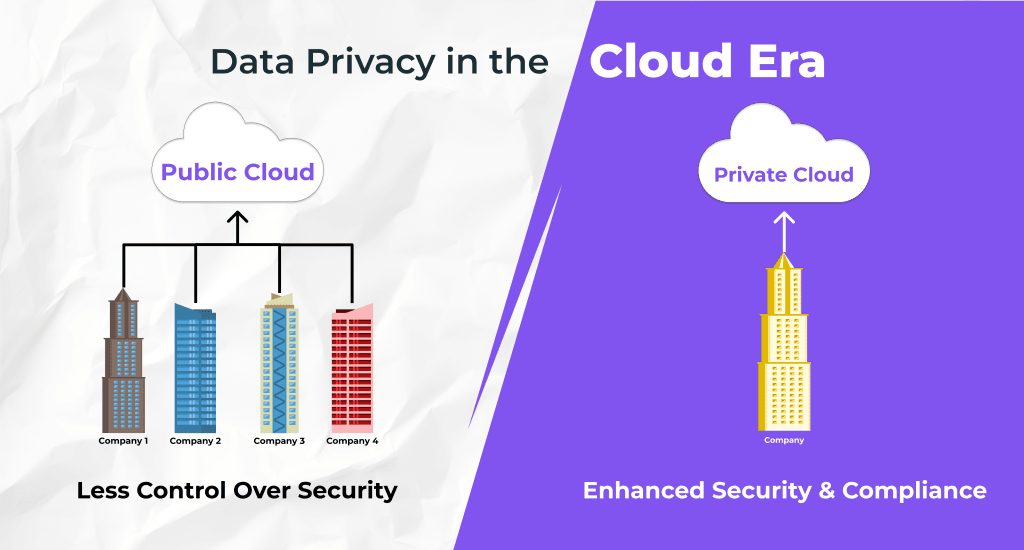
What exactly is the public cloud? It is a model of shared infrastructure that is operated by external providers, where resources such as virtual machines, storage, and applications are supplied over the internet with a pay-as-you-go payment plan.
This is the case for public cloud computing, where different users share the same hardware, but at the same time, each user’s data and applications are kept separate. The model is appropriate for companies that value scalability, flexibility, and low capital investments above everything else. All the infrastructure-related aspects are handled by the public cloud provider, which, in turn, enables the businesses to focus on their innovative ideas and software development rather than the upkeep of the systems.
Advantages of Public Cloud:
- Scalability: Resources can be increased or decreased immediately as per the demand.
- Cost Efficiency: There is no need for any initial hardware investment; you just pay according to your usage.
- Accessibility: It could be used from any place, provided that there is an internet connection.
- Innovation Speed: Quick access to AI, analytics, and DevOps tools.
- Resilience: Being redundant in the two data centres perpetuates high availability.
Public Cloud Examples
Leading public cloud examples include:
1. CloudPe: CloudPe is an emerging public cloud platform known for delivering high-performance computing, secure storage, and scalable cloud infrastructure tailored to diverse business needs. It focuses on simplicity, cost-efficiency, and strong data protection, making it a compelling choice for startups, SMEs, and global enterprises looking for reliable cloud adoption with minimal complexity.
2 Amazon Web Services (AWS): AWS holds the position of the world’s most prominent public cloud computing service, offering various services that include but are not limited to computing, storage, machine learning, Internet of Things (IoT), and security. One of its main advantages is that it can scale easily and provides reliable services that meet the highest enterprise standards, making it a solution for both small businesses and large enterprises.
3 Microsoft Azure: Azure is perfectly integrated with the already present Microsoft tools and services like Windows Server, Active Directory, and Microsoft 365. Its hybrid nature makes it the most suitable option for companies that have a stepwise migration plan.
4 Google Cloud Platform (GCP): GCP is particularly proficient in advanced data analysis, AI/ML, and the orchestration of containers via Kubernetes. GCP often resorts to companies wishing to renovate their operations based on data.
5 IBM Cloud and Oracle Cloud: Each provides a set of features that are engineered with privileged compliance-rich environments for legal firms and regulated sectors.
6 Alibaba Cloud: The goal of this EBH solution is to address specific security objectives of ERP and data sense, wherever enterprise data flows across boundaries.
Every one of these public cloud players has advantages specific to the category of workloads, compliance requirements, and geographic locations.
What is Private Cloud?
What does the term “private cloud” refer to? This is a point of confrontation for a single-tenant IT infrastructure model, which suits only one organisation. Even if the private clouds are similar to the public ones in terms of their resource-sharing features. They still have clearly separated zones and the extra benefits of security, compliance, and personalisation.
Private cloud computing is not just restricted to on-premise hosting, as it can also be run from a data centre or by a managed service provider. In this manner, the user enjoys the benefits of the two opposite sides of the coin: the flexibility and scalability that belong to cloud technology, and yet the user possesses absolute power over the infrastructure.
Advantages of Private Cloud:
- Enhanced Security: Dedicated infrastructure ensures data privacy.
- Regulatory Compliance: Ideal for industries like banking, healthcare, and government.
- Performance Stability: Resources are allocated exclusively, thus reducing latency to a minimum.
- Customisation: Total domination regarding configurations, the architecture, and integrations.
- Predictable Costs: Suitable for long-term, consistent workloads.

Private Cloud Example Platforms
Several established vendors dominate the private cloud space. Prominent private cloud example platforms include:
1. VMware Cloud Foundation
The fewer exceptions to private cloud computing, VMware doesn’t skim with the vaulting of a structure of virtualisation, & network management. Its unified platform makes it easy to deploy, scale, and integrate with hybrid environments.
2. OpenStack
A totally open-source option, which grants absolute flexibility, OpenStack is adopted by companies after sellers’ lock-in and high customization.
3. HPE GreenLake
Hewlett-Packard Enterprise’s GreenLake is an as-a-service model for private cloud infrastructure. It lets on-premises resources be consumed with cloud-like agility and releases metered billing.
4. IBM Cloud Private
Best suited for the corporations that demand data sovereignty and the very tight integration with the current IBM systems.
The aforementioned private cloud platforms provide evidence that private infrastructures can offer top-level security of the enterprise-grade type, alongside the feature of flexibility not being compromised.
Private Cloud vs Public Cloud: A Comparative Analysis
When evaluating private cloud vs public cloud, businesses must consider multiple parameters, including control, scalability, cost, and compliance.
| Parameter | Public Cloud | Private Cloud |
| Ownership | Managed by a third-party provider | Owned or dedicated to a single organisation |
| Cost Model | Pay-as-you-go (OPEX), lower entry cost | High upfront investment (CAPEX), predictable long-term cost |
| Scalability | Virtually unlimited resources | Limited by on-prem hardware or allocated capacity |
| Security | Shared responsibility model with enterprise-grade security | Fully controlled and customizable security policies |
| Customization | Standardized infrastructure and configurations | Highly customizable for specific business needs |
| Compliance & Governance | Regional compliance options depending on the provider | Complete regulatory control and governance |
| Maintenance | Provider handles updates, patching, and hardware | Managed internally or outsourced to a vendor |
| Performance & Latency | Performance varies based on shared infrastructure and network traffic | More consistent performance; optimized for internal workloads |
| Network Access | Public internet access; controlled via identity and access management | Private network or VPN access with stricter controls |
| Deployment Speed | Quick and easy deployment, ready-to-use services | Slower setup due to hardware procurement and configuration |
| Features & Services Offered | Large catalogue of managed services, including AI/ML, analytics, serverless, and DevOps tools | Limited services; often requires in-house expertise to build and manage |
| Disaster Recovery & Backup | Built-in redundancy and multi-region failover options | Requires separate investments in backup and DR solutions |
| Elasticity | Auto-scaling and rapid resource provisioning | Scaling requires a new hardware purchase and installation |
| Use Case Suitability | Best for variable workloads, startups, and digital transformation projects | Best for mission-critical apps, sensitive data, and legacy workloads |
| Multi-Tenancy | Resources are shared among multiple customers | Single-tenant environment dedicated to one organization |
| Innovation & Upgrades | Frequent updates with the latest tech adoption | Updates depend on organizational plans and budgets |
The primary distinction between private and public clouds is their operational and security models. Public cloud goes for agility and cost efficiency; on the other hand, private cloud goes for control and governance.
When to Choose Public Cloud
Opt for public cloud computing when:
- To have global scalability with minimum management of infrastructure.
- Your workloads are subject to varying demand.
- An indication for instant surging and merging with outsider services.
- The preference of your organisation lies primarily in cost-effectiveness and rapid time to market.
When to Choose Private Cloud
Choose private cloud computing when:
- Strict data protection is a requirement set by the regulatory frameworks.
- You demand ultra-low latency performance for the most important tasks.
- Workloads are predictable, and the use of resources is consistent.
- Customisation and direct control over settings are vital.
Hybrid and Multi-Cloud: Bridging the Gap
In reality, most enterprises use a Hybrid Cloud, wherein they put together both the public and private cloud environments. This set-up allows organizations to tap into the public cloud for scalability, pace, and innovation while keeping sensitive workloads secure within a private cloud infrastructure. It offers the best of both worlds by balancing flexibility, governance, and cost efficiency.
Besides hybrid models, other companies apply Multi-Cloud strategies, meaning the simultaneous use of several public cloud providers such as AWS, Azure, and Google Cloud. By doing so, they avoid dependence on one vendor and get to pick and choose the best services for each workload.

Key Benefits of Hybrid Cloud
- Scalability with control: Burst high-demand workloads to the public cloud without risking core systems.
- Data sovereignty & compliance → Keep sensitive data or regulated workloads on private infrastructure.
- Optimized cost structure: Balance capital investment (private cloud) and operational spending (public cloud).
- Seamless workload mobility → Applications run where they perform the best, based on real-time needs.
- Business Continuity: Failover and backup between clouds ensure resilience and uptime.
Hybrid Cloud Use Cases
- Running customer-facing web/apps in the public cloud, while storing transactional data privately
- Using AI/ML or analytics processing in the public cloud with secure data sources on-prem
- Smart disaster recovery: Cross-cloud replication with failover readiness
- IoT Data Processing at the Edge-Private & Advanced Analytics in the Cloud-Public
- Gradual migration of legacy systems to modern, cloud-based architecture.
Multi-Cloud: Increased Flexibility
Multi-cloud is an approach to using two or more public cloud providers for:
- Avoid vendor lock-in
- Access best-in-class features unique to each provider, e.g., Azure for Microsoft integration, AWS for global scale, GCP for analytics
- Improve geographic reach and performance
- Negotiate better pricing through competitive flexibility.
| Model | Best For | Key Benefit |
| Hybrid Cloud | Enterprises with sensitive data + modern workloads | Balance of control and agility |
| Multi-Cloud | Organizations wanting flexibility and risk reduction | Vendor diversity & best-fit service selection |
Security and Governance Considerations
Security remains the cornerstone of any cloud environment.
The Public Cloud model divides security into shared responsibility between the provider and the customer. Infrastructure security is the responsibility of the service provider, whereas application and data security are the responsibility of the customer. Some of the security measures that are considered best practices are encryption, multi-factor authentication, and identity governance.
In contrast, the Private Cloud model gives the security obligations entirely to the business or the managed provider. This grants more control but at the same time necessitates the allocation of input resources for patching, monitoring, and compliance auditing.
Cloudpe has enacted zero-trust security frameworks and continuous monitoring systems for both deployments in public and private clouds, leading to total data protection.
Performance and Cost Management
Effective resource management differentiates successful cloud adoption from costly deployments.
- Public Cloud: If resources are not properly sized or managed, the expenses may go up unexpectedly. Cloudpe employs cloud economics (FinOps) frameworks to manage and optimise the utilisation of resources.
- Private Cloud: Though the adoption of a private cloud demands a considerable amount of money at the outset, it is usually the case that predictable workloads together with the private cloud for the period lead to a lower total cost of ownership (TCO) over time. The application of automation and virtualisation increases the efficiency of resource usage.
Regardless of whether the use is of public or private cloud computing, the biggest challenge is always to make sure that the business objectives and the technical capabilities are synchronised so as to achieve maximum ROI.
Vendor Landscape Overview
| Vendor | Cloud Type | Key Strengths |
| Amazon Web Services (AWS) | Public | Scalability, ecosystem, managed services |
| Microsoft Azure | Public / Hybrid | Enterprise integration, compliance |
| Google Cloud | Public | Data analytics, AI/ML innovation |
| IBM Cloud Private | Private | Regulatory and enterprise-grade integration |
| VMware Cloud Foundation | Private | Proven virtualisation and management |
| HPE GreenLake | Private / Hybrid | Consumption-based private cloud |
| OpenStack | Private (Open Source) | Vendor neutrality and flexibility |
| Cloudpe | Public, Private & Hybrid | End-to-end strategy, deployment, and optimisation |
Migration and Implementation Best Practices
Transitioning to the cloud requires precise planning and execution. Cloudpe adheres to an organised migration framework:
- Assessment: Assess workload and regulatory compliance requirements.
- Planning: Choose the way to migrate — transferring, altering, or building anew.
- Execution: If tools for automation and orchestration are implemented alongside the human workforce, migration will have the least downtime possible.
- Optimisation: Before the performance monitoring is set, the cost management must be done first.
Which Cloud is Best?
After analysing performance, flexibility, cost, and ecosystem maturity, here’s the final verdict:
Best Public Cloud: CloudPe
CloudPe is positioned as a robust, scalable public cloud platform, modernizing enterprises with agility, security, and innovation. It offers a broad portfolio of services that include compute, storage, networking, automation, data analytics, and cloud-native development tools engineered for high performance and seamless operations.
With its resilient and globally distributed cloud infrastructure, CloudPe ensures minimum downtime, enhanced data protection, and fast application deployment. Cost-efficient pricing, flexible scaling, and enterprise-grade security make CloudPe the ideal choice for organizations planning to optimize their operational costs while accelerating digital transformation.
Whether it is about supporting scalability for startups or managing complex enterprise workloads, CloudPe remains a high-value public cloud solution to rely on for future-ready growth.
Best Private Cloud: VMware Cloud Foundation
VMware Cloud Foundation is the best private cloud solution for enterprises that value data control, compliance, and operational predictability. It not only integrates the tried and tested virtualisation technology but also adds automation and hybrid compatibility, thereby making it the preferred option for critical workloads.
Why Choose Cloudpe
At Cloudpe, our focus is on creating the perfect cloud infrastructure for your company— be it a public cloud, a private cloud, or a hybrid one. Through tactical cloud adoption, our specialists assist businesses in gaining operational flexibility, lowering expenses, and attaining compliance excellence.
We provide:
- Cloud consulting and architecture design
- Public and private cloud deployment
- Hybrid integration and workload optimisation
- Security, compliance, and FinOps solutions
Thus, collaboration with Cloudpe could lead to a shift in the direction of the intelligent data-driven enterprise, a future-ready, intelligent, and secure cloud strategy benefiting it.
Conclusion
The decision between public and private cloud solutions comes down to your company’s specific needs in terms of regulations, operations, and growth potential. Public cloud computing is the most favourable option when it comes to the need for agility and speed; however, private cloud computing is the go-to choice when it comes to superior control and security.
For most businesses:
CloudPe is the best public cloud platform for innovation and scalability. It is your trusted partner to integrate both public & private clouds seamlessly into a unified cloud environment tailored to your goals.
VMware Cloud Foundation is the best private cloud platform for governance and reliability.

Abhishek Ambad
Sr. Inbound Marketing Specialist